
Tuesday, May 31, 2011
Lotus stem salad


Tuesday, May 24, 2011
Favorite snack in Hanoi - "Bun Dau"


"Bun Dau" or noodles and soya curd (we can call: bean vermicelli) is a favorite snack in Hanoi. There are also leaf of rice vermicelli (lá bún) is cut into three, fried yellow soya curd, shrimp sauce aftertaste, sour, bitter, salty, sweet, add a little schizonepeta, perilla, but there was so strange things do not mix between "bún" parks in Hanoi.
During four seasons of Northern origin, many people choose for themselves "bún đậu" as breakfast or lunch. The burden go across many streets then down at a fixed point. Customers create their own routines, where is found "bun dau" is a fixed point. In Thanh Xuan district, Ms Lan (age 27) from 7am to carry her noodles across Nguyen Quy Duc street to 10am is finish.
At Cau Giay , on the sidewalk in front of Thu Le Park, from 10:00 am to 12:00 am have six street restaurant line of 'bun dau"sitting in there. Customer is convenience to eat .
Walk slowly up the Hoan Kiem area, near a pharmacy on Hai Ba Trung street is a familiar point of sale bean vermicelli. Ms Ha (52 years) said: "Sitting on the pavement but clean is also interesting in it" .
Bean vermicelli is not expensive , easy to eat at any season any.
Bean vermicelli are liking of tourists or not depends on the grace of the seller. Mrs. Ngan (55 years), live at Hang Thiet street sold bean vermicelli algae on Hai Ba Trung Street nearly ten years. Even at her best hot still laughed, joked a few more questions so that everyone is satisfied.
Linh, the salesclerk of Nguyen Kim supermarkets said: "Eating noodles here but hear talk medical sales look exactly like comedy." Although the burden is empty or a large shop, the sellers all have the word "patience."Guests to eat each one counted, so owners that irritability is: Quarrels all day."
From Khay street has a tray small alley connecting Vu Thach Pagoda. So here is hard to find, but who came here will back. She borrowed the temporary owner of the house an ancient time, though old but very good shade rain cover. Feeling sitting in an old house with the space very interesting particular. The walls were already peeling lime, silver colored wooden doors, small pictures of the owner still hanging on the wall. Apart from the well field is a rainwater tank and a betel rig blue, rustic. She has an enthusiasms of serve for guests and made noodles very careful and clean.
Bean vermicelli are tourists or not depends on the salesgirl.
Mr Dick, (a French tourist) said: "I was a friend of Vietnam led to eat here last week, would love bean noodles, like the low seating, good location bar should be back here today to eat". Outer walls are red brick long bar, if you can save yourself a cute picture.
During four seasons of Northern origin, many people choose for themselves "bún đậu" as breakfast or lunch. The burden go across many streets then down at a fixed point. Customers create their own routines, where is found "bun dau" is a fixed point. In Thanh Xuan district, Ms Lan (age 27) from 7am to carry her noodles across Nguyen Quy Duc street to 10am is finish.
At Cau Giay , on the sidewalk in front of Thu Le Park, from 10:00 am to 12:00 am have six street restaurant line of 'bun dau"sitting in there. Customer is convenience to eat .
Walk slowly up the Hoan Kiem area, near a pharmacy on Hai Ba Trung street is a familiar point of sale bean vermicelli. Ms Ha (52 years) said: "Sitting on the pavement but clean is also interesting in it" .
Bean vermicelli is not expensive , easy to eat at any season any.
Bean vermicelli are liking of tourists or not depends on the grace of the seller. Mrs. Ngan (55 years), live at Hang Thiet street sold bean vermicelli algae on Hai Ba Trung Street nearly ten years. Even at her best hot still laughed, joked a few more questions so that everyone is satisfied.
Linh, the salesclerk of Nguyen Kim supermarkets said: "Eating noodles here but hear talk medical sales look exactly like comedy." Although the burden is empty or a large shop, the sellers all have the word "patience."Guests to eat each one counted, so owners that irritability is: Quarrels all day."
From Khay street has a tray small alley connecting Vu Thach Pagoda. So here is hard to find, but who came here will back. She borrowed the temporary owner of the house an ancient time, though old but very good shade rain cover. Feeling sitting in an old house with the space very interesting particular. The walls were already peeling lime, silver colored wooden doors, small pictures of the owner still hanging on the wall. Apart from the well field is a rainwater tank and a betel rig blue, rustic. She has an enthusiasms of serve for guests and made noodles very careful and clean.
Bean vermicelli are tourists or not depends on the salesgirl.
Mr Dick, (a French tourist) said: "I was a friend of Vietnam led to eat here last week, would love bean noodles, like the low seating, good location bar should be back here today to eat". Outer walls are red brick long bar, if you can save yourself a cute picture.

Mr. Doan, 57, a customer eating noodles on Nguyen Khac Can said: "Eat a bean vermicelli in a delicious and comfortable sidewalks. Hanoi rainy season came, the sun suddenly reminded of medical leaves of Onga Becgon season. "
Sometimes things seemed very simple but also left his heart a sweet aftertaste, and hold a binding elusive, just know that feet get used to a rhythm and go to the old shop. And from that noodles and soya curd that there is still the familiar strange.
Sometimes things seemed very simple but also left his heart a sweet aftertaste, and hold a binding elusive, just know that feet get used to a rhythm and go to the old shop. And from that noodles and soya curd that there is still the familiar strange.
Monday, May 23, 2011
Hanoi Steamed Glutinous Rice (Xoi xeo Ha Noi)

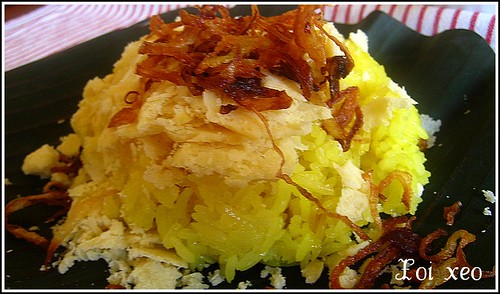
I have never seen any places in Vietnam with many kinds of good steamed glutinous rice like Ha Noi. Ha Noi "xôi" is really a diversified picture of agricultural products of Vietnam. They are "xôi gấc" (steamed glutinous rice with Momordica cochinchinensis), "xôi lạc" (steamed glutinous rice with peanut), "xôi vò" (steamed glutinous rice with split peas), "xôi đậu" (steamed glutinous rice with bean), "xôi ngô" (steamed glutinous rice with corn), "xôi cốm" (steamed glutinous rice with green rice flakes), "xôi dừa" (steamed glutinous rice with coconut), "xôi thịt" (steamed glutinous rice with cooked pork), "xôi chả" (steamed glutinous rice with pork pie), etc. Each kind of "xôi" is a real creative art and a wonderful combination of ingredients. Among these kinds of "xôi", I am the most impressive with "xôi xéo" since it is really special even with its name as "xôi xéo".
"Xôi xéo" is normally sold in the morning at almost all alleys in Ha Noi. It is sold by peddlers who carry bamboo frames on their shoulder or ride a bike. No one knows when "xôi xéo" came into being in Ha Noi; however it has become a popularly special dish for breakfast. Students and workers enjoy this dish the most. It is quite understandable since it is cheap, gives feeling of fullness and it is easy to eat.
No matter where you enjoy this dish in the city, its ingredients are the same with steamed glutinous rice, bean, fried onion, and liquid fat. "Xôi xéo" is good thanks to glutinous rice selection to make it glutinous without being much pasty. Bean is steamed, well-kneaded and rolled into big balls so that they can be thinly planed. Onion is fried and it must not be too brown. This dish must be soused with liquid fat which is clear and viscid. In order to keep it as liquid (not to be solidified) in Winter, liquid fat is always put on a brazier.
In the morning, drop by a shop of steamed glutinous rice with lots of choices, seeing seller who skillfully make "xôi xéo", you definitely take it for your breakfast. A big bowl of "xôi xéo" may keep you full till late noon. If affordable, you may require seller to add some salted shredded meat. It only costs you VN3,000 to VND5,000 to enjoy that good dish for your breakfast.
"Xôi xéo" is normally sold in the morning at almost all alleys in Ha Noi. It is sold by peddlers who carry bamboo frames on their shoulder or ride a bike. No one knows when "xôi xéo" came into being in Ha Noi; however it has become a popularly special dish for breakfast. Students and workers enjoy this dish the most. It is quite understandable since it is cheap, gives feeling of fullness and it is easy to eat.
No matter where you enjoy this dish in the city, its ingredients are the same with steamed glutinous rice, bean, fried onion, and liquid fat. "Xôi xéo" is good thanks to glutinous rice selection to make it glutinous without being much pasty. Bean is steamed, well-kneaded and rolled into big balls so that they can be thinly planed. Onion is fried and it must not be too brown. This dish must be soused with liquid fat which is clear and viscid. In order to keep it as liquid (not to be solidified) in Winter, liquid fat is always put on a brazier.
In the morning, drop by a shop of steamed glutinous rice with lots of choices, seeing seller who skillfully make "xôi xéo", you definitely take it for your breakfast. A big bowl of "xôi xéo" may keep you full till late noon. If affordable, you may require seller to add some salted shredded meat. It only costs you VN3,000 to VND5,000 to enjoy that good dish for your breakfast.
Thursday, May 19, 2011
Com hen song Huong (Perfume River mussel cooked rice)


“Com hen Song Huong” is a dish served at room temperature, made with mussels and leftover rice. It is a complicated recipe that includes sweet, buttery, salty, sour, bitter and spicy flavors.
Com hen Song Huong (or Com hen in short) is the very simple and low-priced specialty of Hue, the ancient citadel of Vietnam. Accordingly, the way of serving this special kind of food is of great ancience, simplicity and deliciousness.
Com hen has a sweet-smelling flavor of rice, onion, and grease, as well as strange tastes of sweet, buttery, salty, sour, bitter, and peppery-hot. You have to arrive to Hen river-islet in the Perfume River to have the original Com hen. However, you can find out the dish on some streets in Hue City. It requires 15 different raw materials to prepare for the dish, including mussel, fried grease, watery grease, peanuts, white sesames, dry pancake, salted shredded meat, chilly sauce, banana flower, banana trunk, sour carambola, spice vegetables, peppermint, salad, etc.
Com hen Song Huong (or Com hen in short) is the very simple and low-priced specialty of Hue, the ancient citadel of Vietnam. Accordingly, the way of serving this special kind of food is of great ancience, simplicity and deliciousness.
Com hen has a sweet-smelling flavor of rice, onion, and grease, as well as strange tastes of sweet, buttery, salty, sour, bitter, and peppery-hot. You have to arrive to Hen river-islet in the Perfume River to have the original Com hen. However, you can find out the dish on some streets in Hue City. It requires 15 different raw materials to prepare for the dish, including mussel, fried grease, watery grease, peanuts, white sesames, dry pancake, salted shredded meat, chilly sauce, banana flower, banana trunk, sour carambola, spice vegetables, peppermint, salad, etc.

Com hen is always attractive to many customers since it is tasty and, at the same time, economical to anybody.
What makes this simple kind of food popular is revealed in the great endeavor to adopt and process its main ingredient – mussel. Mussels are sea species, which must be dipped in water for a long while before being processed. Accordingly, people often say that com hen somehow expresses the strenuous work of the maker.
Where to find it? Very easy as it is popular everywhere in Hue and these days, elsewhere in Hue restaurants in Vietnam. More favorably, it is a low-priced specialy, thus you could eat it in luxurious restaurants in Hue or even in vendoring mobile shops on the streets.
“Visiting Hue could not miss Com hen, or else you have not come to Hue ever!” is the most common remark of visitors elsewhere to Hue. So, please come and enjoy it yourself!
What makes this simple kind of food popular is revealed in the great endeavor to adopt and process its main ingredient – mussel. Mussels are sea species, which must be dipped in water for a long while before being processed. Accordingly, people often say that com hen somehow expresses the strenuous work of the maker.
Where to find it? Very easy as it is popular everywhere in Hue and these days, elsewhere in Hue restaurants in Vietnam. More favorably, it is a low-priced specialy, thus you could eat it in luxurious restaurants in Hue or even in vendoring mobile shops on the streets.
“Visiting Hue could not miss Com hen, or else you have not come to Hue ever!” is the most common remark of visitors elsewhere to Hue. So, please come and enjoy it yourself!
(Source: Le Trang- Vietnam-beauty.com)
Wednesday, April 13, 2011
"Banh Chung" - the soul of Vietnamese New Year

"Banh Chung" (Chung cake) is a traditional and irreplaceable cake of Vietnamese people in the Tet Holidays and King Hung’s anniversary (10th March Lunar). For the Vietnamese, making "Banh Chung" is the ideal way to express gratitude to their ancestors and homeland.
Banh Chung
The legend of " Banh Chung"
Chung cake was invented by the 18th Prince of Hung Emperor in the contest of looking for new Emperor. According to the legend, 3,000-4,000 years ago, Prince Lang Lieu, made round and square cakes, the round Day cake symbolizing the sky and the square Chung cake symbolizing the Earth (under the ancient Vietnamese perception), to be offered on the occasion of Spring.
In the ancient conception, the Earth is square, hence Chung cake's shape is square, too, to reflect the Earth shape. Since the cakes he offered were of special meaning and delicious taste, Lang Lieu was selected to be the next Emperor. Since then, in honor of this 18th Prince, Vietnamese people always make and have Chung cake in the Lunar New Year. Up to now, Chung cake has become the most famous and irreplaceable traditional Vietnamese food in Tet Holiday. This legend aims to remind the next generations of the ancient tradition as well as the primary of Chung cake. Besides, it emphasizes the important role of rice and nature in water rice culture.
How to make a "Banh Chung"?
In contrast to the fast food in modern life, the process of making Chung cake is time-consuming and requires the contribution of several people. Main ingredients are glutinous rice, pork meat, and green beans wrapped in a square of bamboo leaves that will give the rice a green color after boiling. The
sticky rice must be very good and was soaked in water in the previous day. Rice cake is wrapped in square shape, and the wrapping power must be neither tight nor loose. Then the cake will be boiled in about 12 hours by wood. The Green Chung cake has nutrition with an original tasty flavor and may be kept for a long time. Eating Chung cake with vegetable pickles will bring you unforgettable taste!
In the traditional conception of Vietnamese people, the process of making Chung cake is the opportunity for family to come together. Sitting around the warm fire, all members in the family tell one another the past stories and are ready for a New Year with wishes of best things. Nowadays, in some big cities, the business lifestyle of modern society prevent people from preparing the cake, however, the habit of worship ancestors with Chung cake never changes. It is the evidence of the Vietnamese loyalty and deep gratitude to ancestors.
Friday, April 1, 2011
Hue beef noodle – the typical culinary art of Hue!

In Hue city, the former citadel of Vietnam, it doesn't take you a lot of money to dine like a King!
Hue beef noodle takes its origin from the Royal Hue City of Central Vietnam. The broth is from cooking beef bones for a long period of time as well as a variety of different spices including lemongrass.
How does it taste? Well, having a bowl of Hue beef noodle, you will easily recognize that it is completely different from Pho since the former’s beef broth is much more spicy.
How to make it? Learning how to make a clear broth from bone and meat is quite a difficult task. After being selected from the market, the fresh beef will be shredded, boiled and taken out of the water to obtain a delicious clear broth. A typical version of Hue beef noodle must include pork, roast beef, pig’s blood, Vietnamese salami, Hue’s style salami, shrimp sauce and chopped lettuce.
The interesting thing is that, the amount of salt put in the beef noodle recipe varies between seasons. For example, during summer, Hue beef noodle soup is served with soy bean, mint and different kinds of lettuce while in the winter, the recipe is saltier added with lemongrass and fish.
The best Hue beef noodle comes from the street vendors who work from dawn to early morning. In Hue, when night lights are on, you can enjoy a good bowl of this noodle soup at restaurants in front of No. 84 Mai Thuc Loan Street. This hot dish represents just a few of the treasures of Hue's traditional cuisine. Clam-rice and the flour pies like beo (streamed flour cupcakes), nam (wrapped shrimp pies) and loc (tapioca and shrimp pies), for examples, are part of the ancient capital's culinary heritage.
Where to have Hue’s beef noodle in Ha Noi?
You are in Hanoi, and wondering if such a Hue’s specialty appears in Hanoi or not. Don’t worry, Hue beef noodle come up quite often in many streets of Hanoi from morning till night. It’s better to ask your hotel to recommend a place nearby or you can refer to the following reliable addresses:
• No. 4 Ly Thuong Kiet Street, Hanoi
• No.467 Đoi Can Street, Hanoi
• No.7 Thai Phien Street, Hanoi
• No.22 Phan Boi Chau Street, Hanoi
• No.175 Lang Ha Street, Hanoi
• No.G23 Huynh Thuc Khang Street, Hanoi
Thursday, March 31, 2011
Bun (rice vermicelli), the origin for many Vietnamese delicious dishes!

Bun (Rice vermicelli) is made of rice flour which is turned into small, circular and white threads wrapped up into small coils called Con Bun. Vietnamese rice vermicelli is a preferable as well as a popular dish!
The best rice noodles have only two ingredients: rice or rice flour, and water. Rice vermicelli are thin, translucent noodles that are similar to cellophane noodles, with which they are often confused (rice vermicelli are made from rice; cellophane noodles are made from bean starch). There are different varieties of vermicelli depending on their shape: bun roi (stirred vermicelli), bun mam (twisted vermicelli), bun la (vermicelli paper), and bun dem tram (shreded vermicelli).
Rice vermicelli noodles are delicious and easy to prepare. Let’s see how rice vermicelli dishes are prepared step by step!
Before cooking, simply soak rice vermicelli in warm (not hot) water for just two minutes. Then, in order to have a delicious bowl of rice, you should add different kinds of ingredients and vegetables. You can choose one of various ingredients that can be served with vermicelli such as: grilled pork meat, fried rice cakes, snails, fried eggs, lean meat pie, chicken, and crab soup, etc.
Do not be so surprised if you see that each region and locality, even each restaurant, has its own vermicelli dishes with their own recipes. There are a variety of ways to enjoy rice vermicelli, each dish having its own unique taste, for example: “Bun Cha” (vermicelli and grilled chopped meat), “Bun Rieu” (vermicelli and sour crab soup), “Bun Bo” (vermicelli and beef ), “Bun Oc” (vermicelli and snails) and so on.
Let’s try the very delicious taste of Bun Cha and Bun Oc! Bun Cha (Vermicelli and grilled chopped meat) includes rice vermicelli, grilled pork and spicy, raw vegetables and well mixed fish sauce. For a dish of Bun Cha, you take a dish of rice vermicelli, a dish full of vegetables and a bowl of fish sauce combined with vinegar, sugar, hot chilly, garlic and pepper. The sauce will then contain all the essential tastes, sour, hot, salty and sweet. Grilles of well cooked pork would be opened and the contents dropped into the bowl of fish sauce. There are two kinds of Cha (grilled pork) used, depending upon the cut of the meat. If the pork is cut into small pieces, it is called Cha Mieng (piece of grilled pork). If it is minced prior to being shaped into small cubes, it is named Cha Bam (minced grilled pork). Bun Oc (Rice vermicelli with fresh water snail) has fresh water snails as main ingredient. These snails will have been kept in clean fresh water for about ten hours before being boiled for the dish, to allow sufficient time for the snails to release any organic matter they may have in their shells. The boiled snails after being taken out of their shells would be cleaned. The soup for the dish is made from the water in which snails have been boiled in. To the soup is added tomatoes and several kinds of flavour and vinegar.
Rice vermicelli are a part of different Vietnamese cuisines.Walking along some streets and stopping at one rice vermicelli vendor in Hanoi or Sai Gon, you will have chances for tasting various dishes of rice vermicelli with unforgettable flavor!
Subscribe to:
Posts (Atom)